
A free Lean Six Sigma game you can play in your browser
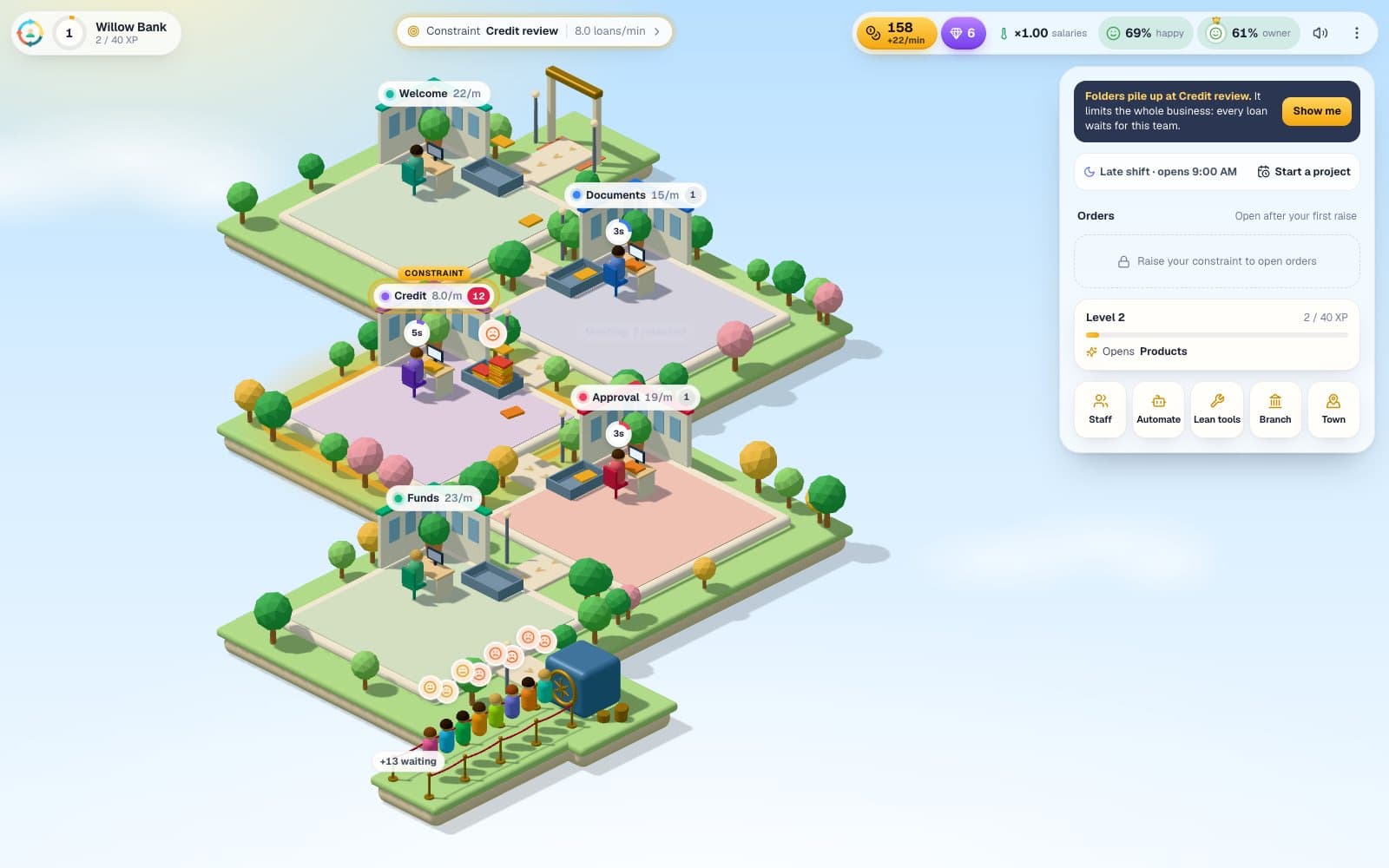
Run a bank branch, find the bottleneck and fix the flow. No sign-up to start, and nothing to install.
 Play FlowTown free
Opens the game. No account needed to start.
What you’ll learn while you play
FlowTown is a business game, not a quiz. You learn the ideas by running into them.
The constraint sets the pace.
Your branch has four teams: greet, check, approve and pay. One of them always has the tallest pile. That is your bottleneck, and the whole branch moves at its speed. If you add staff anywhere else, you only add wages. This is the core of Goldratt’s Theory of Constraints: find the constraint, exploit it, subordinate everything else to it, then elevate it.
Queues are a symptom.
A long line in front of a team tells you where the work waits. It doesn’t tell you why. In FlowTown, as in a real process, you fix the cause (capacity, rework, mix) and not the line.
Less work in progress, shorter lead time.
Little’s Law says average work in progress = throughput × average lead time (L = λW). Hold throughput steady, cut the WIP, and lead time falls with it. Limit what’s in the system and customers get out faster.
Quality is built in, not inspected in.
Automation in FlowTown is cheap and fast. The AI agents also make mistakes, though, and if nobody checks their work you pay the fines. Every Black Belt has seen the same trade-off between speed and first-pass yield.
Decisions have a cost.
Hiring heats the job market, letting people go costs severance, and every choice shows up in profit. The game rewards the improvement that pays back, not the one that looks busy.
Why the queue explodes (the 2-minute version)
Most people expect waiting time to grow in step with how busy a team is. It doesn’t. For a single queue with random arrivals and random service times (the M/M/1 model), the average wait is proportional to ρ / (1 − ρ), where ρ is utilization:
| Utilization (ρ) | Relative wait, ρ / (1 − ρ) |
|---|---|
| 50% | 1 |
| 80% | 4 |
| 90% | 9 |
| 95% | 19 |
Going from 90% to 95% busy roughly doubles the wait. Kingman’s formula extends this to any arrival and service pattern: wait grows with utilization and with variability. That’s why “keep everyone 100% busy” ruins lead time, and why reducing variation (the Six Sigma half) matters as much as removing waste (the Lean half).
You’ll see this happen in FlowTown when a crowd surge hits a team that was already near capacity.
For trainers and classrooms
FlowTown works as a 10-minute warm-up before a session on flow, TOC or queueing. Give the room a link, let everyone run their branch, then ask: “Where was your bottleneck, and what did adding staff elsewhere do to profit?” Players need no account to start.
If you teach Lean Six Sigma, LeanProjax Academy lets approved instructors run courses and cohorts, with learners practising on training projects. Create a free account to apply.
The video plays from YouTube once you press play.
When you’re ready for a real project
The game teaches the ideas. When you have real numbers:
Free calculators, no sign-up
The LeanProjax workspace: run a full DMAIC project with the charter, SIPOC, fishbone, FMEA, control charts and capability in one place. Statistics are checked against reference values, and the numbers never come from AI. It’s free during the pilot. Create a free account
Questions
Is FlowTown really free?
Yes. You can play in your browser as a guest without an account: the bank and the café, up to level 8, kept in your browser. A free LeanProjax account opens the town’s other seven places and saves your town, so you can carry on from any phone, tablet or computer.
Is this a Six Sigma certification or a DMAIC simulation?
No. FlowTown is a business game about flow: bottlenecks, queues, WIP, built-in quality and the cost of decisions. It doesn’t certify anyone. To run a real DMAIC project, use the LeanProjax workspace.
How is it different from classroom games like the dice game or the paper airplane game?
Those are great in a room with a facilitator. FlowTown is single-player and runs in a browser, so anyone can play it alone in a few minutes. It also keeps going: your town grows, disasters hit, and your choices pile up.
Which Lean ideas does it cover?
The constraint (Theory of Constraints), queues and waiting, limiting WIP, quality built in, standard work and Kaizen, and when automation pays.
Who made it?
LeanProjax, a platform for running Lean Six Sigma improvement projects end to end.